Showing posts with label Mechanical. Show all posts

Saturday, October 3, 2020

5000 km (crash)


The past two km chiliads (since 3000 km) were notable for two accidents, keeping the rate at a stubborn one per 1000 km.  First, a minor low-speed tip-over that occurred while playing tag with a relative on roller skates.  Some people take pride in playing hard.  The second was more troubling:

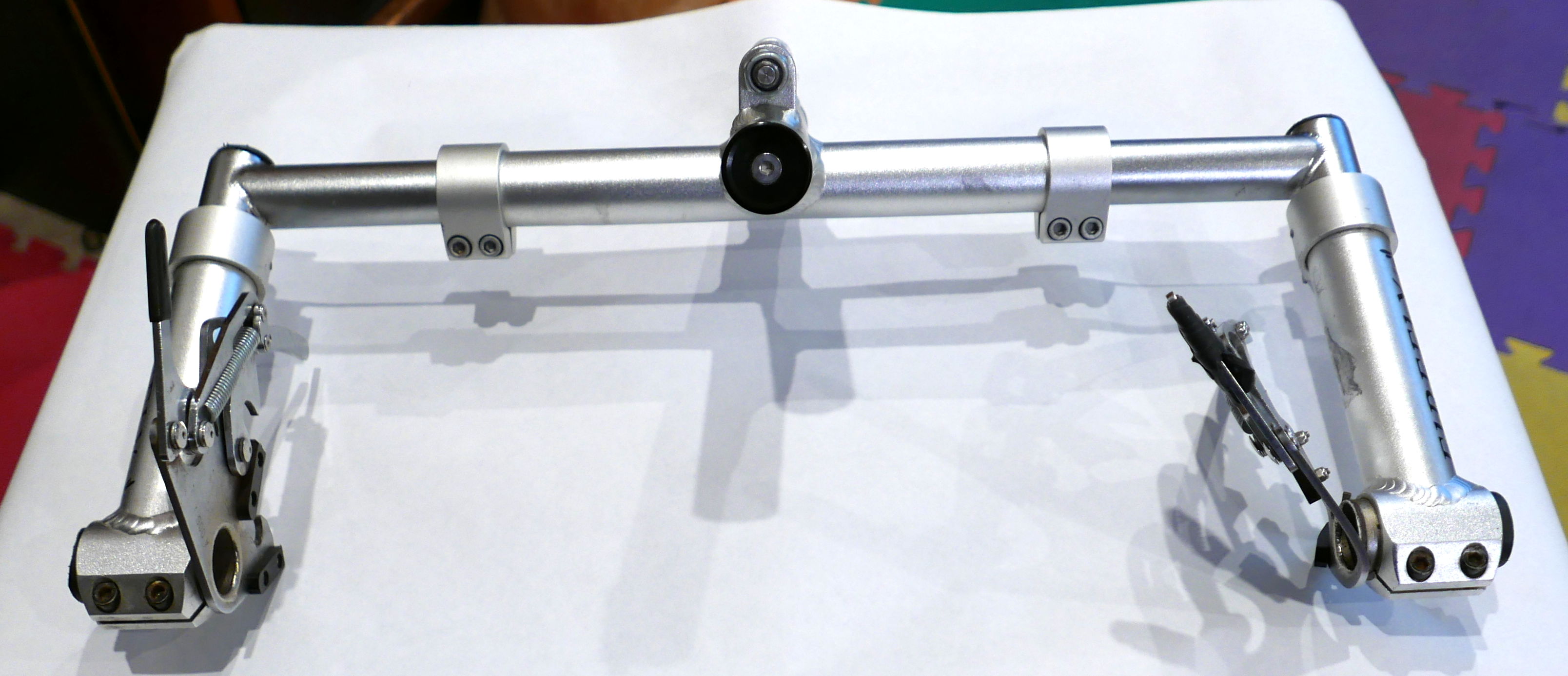
Near the top speed (23 km/h), I lost steering control and crashed diagonally into a curb, causing the wheelchair to flip. I think the left Firefly attachment had separated from the wheelchair, and the right clamp by itself was too weak (picture below), causing the loss of steering. 

I don't know why the left connection let go.  Perhaps I forgot to flip the quick-release lever or the pins weren't fully seated or resonance caused the mechanism to disengage. Just before the crash, I rode over a rumble strip whose vibrations must have caused the final separation. It would be wise to check for any self-loosening in the future and maybe add latch retainers.

Fortunately, the bruising and road-rash are temporary.  I replaced the trashed right-side attachment clamp, but my wheelchair is crooked now, with the right frame leg bent back by about half an inch and downward by a quarter inch.  Considering my usual routes, the consequences of veering sideways uncontrollably could have been a lot more serious.



On a positive note, the QIND Q-211 tire continues to last beyond 2400 km with no visible cords. The front axle has stayed tight since switching to the VESC controller nearly 700 km ago, despite heavy use of regen-braking.


Wednesday, August 19, 2020

Disc brake

Alas, sometimes we must stop.  The disc brake has good strength, but often caused strong brake judder that seemed to get amplified by a resonance.  At times, it felt like riding a washing machine full of bricks during spin cycle.
😰
A long-ago attempt at improvement involved swapping the stock brake caliper with an Avid BB7 MTB, but that just made the brake noisier.  Women would turn because they thought someone was whistling at them, but it was just brake squeal. 
😗
More recently, I replaced the brake rotor (140 mm diameter) with a $10 "ZENO" part.  This rotor, together with new "Resin Organic Semi-Metal Brake Pads" make the brake smooth and quiet.  After installation, I bedded-in the new pads and disc.  Now there's no more judder or brake squeal!
😇
The original disc was a little warped, and I suspect it had periodic variations in braking friction that got amplified in a flexing resonance.  The resonance seemed to get worse with front tire deflation.

Thursday, June 20, 2019

Axle creak

After each of the last two front tire changes, a creak developed that correlated with throttle movement (but not braking).  The creak was caused by torque-transfer from the motor.

To eliminate the creak, it was necessary to make the left axle nut (which presses on a torque-transfer washer) very tight (33 lb ft?).  Given how little material cross-section is in the axle at the left side where the electrical cable comes out, there may be danger of the axle snapping off.  Is there a recommended tightening-torque for the axle nuts?

Closer inspection of the torque transfer washer shows (see picture) that it contacts the fork dropout slot on one side but not the other.  Presumably, the use of motor braking causes the torque direction to switch, and the transfer washer rotates to contact at the other side.  After many cycles of back-and-forth torque transfer, the axle nut gets loose, and a creak develops.  

As others have discussed:
"Regen braking can slowly loosen the axle".
See also this and this thread.  They suggest using thread locker (Loctite 242) and adding washers that allow rotation between the nut and torque arm (in this case torque washer).

No fit is perfect, and the axle will have some rotation with respect to the torque transfer device. But the axle shouldn't rotate with respect to the nut, or the nut will get loose. So there needs to be differential rotation between the nut and torque washer.

To favor desired rotation (axle and nut rotate together with respect to torque washer) over undesired rotation (axle rotates with respect to torque washer and nut), we want more friction between the nut and axle (thread locker) and less friction between the nut and torque washer (add lubricated plate washers).


8/31/2019 Update:  400 km ago, I added a smooth washer between the right axle nut and dropout, and also applied Loctite 243 to that thread.  The left axle nut is tight but has no extra washer or Loctite.  The axle creak, which was coming back every 100 km or so, has stayed away.

5/13/2020 Update:  600 km after the 8/31/2019 update, I noticed that both left and right axle nuts were very loose.  The loosening and creaking problem is unsolved.  Now I am re-torquing the nuts every 150 km or so.  A new motor controller might be easier on the axle and nuts.

Fall, 2022:  After over 3000 km on the smooth new motor controller, the axle has stayed tight despite heavy regen-breaking.  For the previous loosening, I blame the re-synchronization jerk of the original controller when engaging the throttle after coast.  Despite its briefness, this always felt like the most violent part of the ride.  It stands to reason that the repeated torque impulses (about one per km) gradually loosened the axle.

Thursday, October 4, 2018

Parking brake

My Firefly came with a button on the right brake lever that you could press to hold the brake for parking.  This feature is great, because you can stand the Firefly up in a corner when not in use, or set the brake at a traffic light and use both hands for your phone, to dig in your bag, etc.  This is also a safety feature, because once the parking brake is engaged, accidental throttle activation has no effect.  But after about 500 km (300 miles), the button broke, and all of the parts scattered around!
What's left of the original brake-hold button.  The spring is missing and the bottom head broke off.

So I contacted the manufacturer (Rio Mobility), and they wrote that others were having the same problem, and their "solution" was to remove the brake-hold feature!  No warranty fix is possible.  I can sympathize, since the company probably doesn't want to be in the brake-lever engineering business.

But I have an affinity for mechanics, and giving up on this little bit of sweetness was not so satisfying.  Clearly, the button breaks because every time you release it, a spring causes it to pop up and smack into the brake housing with large peak forces.  The poor button can't withstand the repeated violence, and the part fails.  This seems like a design flaw, but most users of these brake levers are on bicycles or recumbents, and they won't use the brake-hold enough to cause failure during the warranty period.

After some experimenting, I ordered a replacement brake lever (Sun BL46K) for $13 that includes a brake-hold button.  This has a slightly higher quality feel than the original, but the brake-hold mechanism appears to have the same not-so-good design.

Fortunately there is a simple fix!  You can take a small cushioning washer like McMaster 93650A100 and stretch it over the bottom of the brake-hold part like a rubber band.  Now the brake lever can last a long time, because the peak forces that caused the part to fail are much lower.  Feature restored!

The red oval shows where the cushioning washer (which is transparent) was stretched over the bottom of the brake hold button.

Update (October, 2021):  Over 6000 km later, the brake-with-rubber-washer works as well as ever.  This page will be updated if a problem develops.